Get free delivery on orders over $100
Low Air Loss Mattress: How It Works, Who Needs One, and What to Look For
Low air loss mattresses use micro-perforated air cells to reduce pressure and manage moisture for people at risk of skin breakdown. Learn how they work, how they compare to alternating pressure, and what matters when choosing one.
Cerigra Team
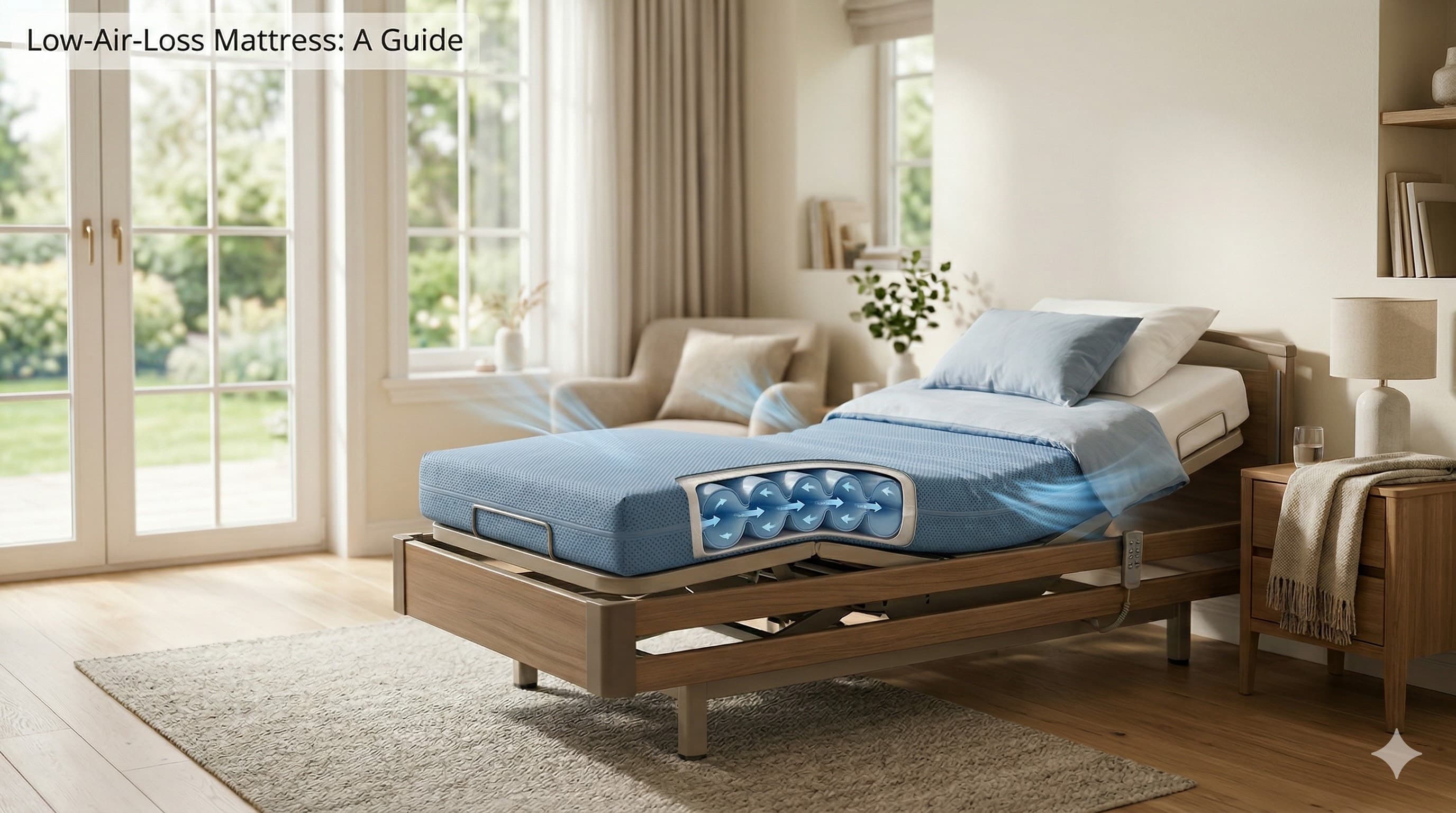
A low air loss mattress is a powered support surface that continuously moves small amounts of air through micro-perforated cells to reduce pressure on the skin and wick away moisture. It is one of the most effective mattress systems available for people who spend extended time in bed and are at risk for -- or already dealing with -- pressure injuries.
If a clinician has recommended a low air loss mattress, or you are researching one for a parent or family member who needs more support than a standard foam mattress provides, this guide covers how the technology works, who it is designed for, how it compares to alternating pressure systems, and what to prioritize when you are ready to buy.
How a Low Air Loss Mattress Works
The core technology is straightforward. A low air loss mattress contains a series of air cells -- typically 10 to 20 large bladders arranged side by side, though some designs use many more smaller cells for finer contouring -- -- connected to an electric pump. The pump inflates the cells to a calibrated pressure, and each cell has tiny laser-cut perforations along its top surface.
Those perforations serve two purposes at once.
Pressure redistribution. The air cells conform around the body rather than pushing back against it, spreading weight across a larger surface area. This reduces the concentrated pressure on bony prominences -- the sacrum, heels, shoulder blades, and hips -- where pressure injuries most commonly develop.
Moisture management. The continuous airflow through the perforations creates a thin layer of moving air between the patient and the mattress surface. This helps evaporate perspiration and keeps the skin drier. Moisture is a significant contributing factor to skin breakdown, so this airflow does real work beyond comfort alone.
The pump runs continuously, maintaining consistent cell pressure and airflow. Most home care models operate in the range of 30 to 45 decibels -- roughly the volume of a quiet room or a soft hum -- though noise levels vary by manufacturer and pump quality.
Some advanced models add features like automatic pressure adjustment based on the person's weight and position, zone-specific firmness controls, or pulsation modes that create gentle alternating movement within the air cells. These features increase the price but can be valuable for higher-acuity situations.
Who Needs a Low Air Loss Mattress
Low air loss mattresses are not a general-purpose upgrade. They are designed for specific clinical situations, and a healthcare provider is the right person to determine whether one is appropriate. That said, here are the scenarios where they are most commonly recommended:
People at high risk for pressure injuries. If a clinician has assessed someone as high-risk using a tool like the Braden Scale, a low air loss mattress provides a level of active pressure management that passive foam or gel mattresses cannot match.
People with existing pressure injuries. For someone who already has a pressure injury (Stage 2 or higher), low air loss is frequently part of the care plan recommended by clinicians. The combination of pressure redistribution and moisture control helps create conditions that clinicians consider appropriate for wound management. The specific mattress and settings should be guided by the treating clinician.
People who spend most of the day in bed. Anyone who is bed-bound or semi-bed-bound -- spending 15 or more hours a day in bed -- faces sustained pressure that even a high-quality foam mattress cannot fully offset over time.
People with moisture management needs. Excessive perspiration, incontinence, or conditions that compromise skin integrity make the airflow feature especially important. Moisture softens the skin and makes it more vulnerable to friction and shear forces, both of which contribute to breakdown.
People who cannot reposition themselves. Someone who cannot shift position independently -- due to paralysis, severe weakness, or sedation -- relies on the mattress to do more of the pressure management work.
Low Air Loss vs. Alternating Pressure: Key Differences
This is one of the most common questions people have when choosing a powered support surface, and the answer depends on the specific clinical need.
How Alternating Pressure Works
An alternating pressure mattress uses air cells connected to a pump that inflates and deflates cells on a timed cycle -- typically every 5 to 10 minutes. When one set of cells deflates, the corresponding skin area gets temporary pressure relief. The cycle then reverses. This creates a rhythmic shifting pattern that prevents sustained pressure on any single spot.
Side-by-Side Comparison
| Feature | Low Air Loss | Alternating Pressure |
|---|---|---|
| Primary function | Continuous pressure redistribution + moisture management | Cyclic pressure relief |
| Airflow | Yes -- constant airflow through micro-perforated cells | No -- cells are sealed |
| Moisture control | Active (air wicks moisture from skin surface) | Passive only (depends on cover material) |
| Movement sensation | Minimal -- feels like a stable, softly inflated surface | Noticeable -- the inflate/deflate cycle creates gentle movement |
| Noise | Continuous low hum from the pump | Intermittent pump noise during cycles |
| Typical price range | $500 -- $2,000+ | $200 -- $600 |
| Common use case | High-risk or existing pressure injuries, moisture issues | Moderate risk, prevention-focused |
When to Choose Each
Choose alternating pressure when the goal is prevention for someone at moderate risk who does not have significant moisture issues. Alternating pressure is effective, more affordable, and widely available. It is a solid step up from passive foam for someone who cannot reposition frequently.
Choose low air loss when the person has existing skin breakdown, high risk scores, significant moisture management needs, or will be in bed for the majority of the day. The continuous airflow and pressure redistribution provide a more comprehensive support environment.
Combination systems exist that offer both alternating pressure and low air loss in a single mattress. These use alternating inflate/deflate cycles while also pushing air through perforated cells. They are typically priced at the higher end of the low air loss range and are worth considering when a clinician recommends features of both technologies.
Your healthcare provider can help determine which system matches the clinical situation. Do not upgrade or downgrade a support surface without consulting the care team, especially if wound care is involved.
Full Replacement Mattress vs. Overlay
Low air loss systems come in two form factors, and the choice affects compatibility, cost, and performance.
Full Replacement Mattresses
A full replacement low air loss mattress replaces the existing hospital bed mattress entirely. It sits directly on the bed's mattress deck and includes the air cell system, cover, and pump as a complete unit. Full replacement models are typically 8 to 10 inches thick and sized to standard hospital bed dimensions (36 x 80 inches). For a broader overview of mattress types and sizing, see our hospital bed mattress buying guide.
Advantages: Better overall pressure redistribution since the entire sleep surface is active. No foam base underneath means the air system does all the work, generally providing lower interface pressure.
Considerations: Higher cost (usually $500 to $2,000+). Heavier and more complex to set up. Requires a compatible bed frame with adequate weight capacity.
Overlays
A low air loss overlay is a thinner system -- typically 4 to 5 inches -- designed to sit on top of an existing mattress. The foam mattress underneath provides the base support, and the overlay adds the air cell and airflow layer on top.
Advantages: Lower cost (often $300 to $800). Easier to set up and remove. Can convert an existing foam mattress into a low air loss surface without replacing it entirely.
Considerations: The overlay adds height to the sleep surface, which can reduce the effective height of side rails -- a safety concern worth checking. Performance also depends partly on the quality of the mattress underneath. If the base mattress has bottomed out, an overlay on top of it will not perform well.
For most home care situations where a clinician has recommended low air loss, a full replacement mattress delivers more consistent results. Overlays work well as a step-up solution or when the budget does not allow a full replacement.
Medicare Coverage and Cost
Low air loss mattresses are classified as Group 2 support surfaces under Medicare's Durable Medical Equipment (DME) benefit. Medicare may cover a low air loss mattress when specific conditions are met:
- The patient has a pressure injury (typically Stage 2 or higher) that has not improved with a Group 1 support surface and appropriate wound care, or the patient meets other specific medical criteria documented by a physician.
- A physician writes a detailed order including the diagnosis, medical necessity, and the specific type of support surface needed.
- The supplier is a Medicare-enrolled DME provider.
Coverage details, copay amounts, and qualifying criteria change periodically. Your healthcare provider's office can often help with the documentation process.
Private insurance coverage varies widely. Some plans cover therapeutic support surfaces with prior authorization; others do not. Ask your insurer about coverage before purchasing, and keep all clinical documentation organized.
Purchase vs. Rental
Some DME suppliers offer low air loss mattresses for rental rather than outright purchase. Rental prices typically run $150 to $400 per month, which can make sense for short-term needs -- recovery from a surgical wound, for example -- but adds up quickly for long-term use. Purchase prices range from roughly $500 to $2,000+ depending on the system.
If the need is likely to last more than four to six months, purchasing is usually more cost-effective. For shorter or uncertain timeframes, rental lets you evaluate the system before committing.
What to Look for When Buying
Not all low air loss mattresses are built to the same standard. Here is what matters most when comparing options.
Pump Quality
The pump is the heart of the system. Look for adjustable pressure settings, a clear control panel, and low noise output. A good pump will auto-compensate for air loss when the person changes position or sits on the edge of the bed. Check whether the pump has a static mode that locks the cells at firm pressure for transfers in and out of bed -- this is a practical safety feature.
Cell Design
The number, size, and arrangement of air cells affect how well the mattress conforms to the body. More cells generally mean better contouring. Some mattresses use a cell-on-cell design -- two layers of air cells -- for deeper immersion and more effective pressure distribution. Check whether individual cells can be replaced if one fails, which extends the overall life of the system.
Weight Capacity
Standard low air loss mattresses typically support 300 to 450 pounds, though ratings vary by manufacturer. Bariatric models go up to 500 to 1,000 pounds but require a wider bed frame. Make sure the mattress weight capacity matches the user's needs with some margin to spare.
Power Backup
Because the pump must run continuously, a power failure means the mattress gradually loses inflation. Some models include a battery backup or a CPR quick-deflate valve. At minimum, the pump should have an alarm that alerts caregivers if power is interrupted or cell pressure drops below a safe threshold.
Cover Material
The mattress cover should be fluid-resistant, vapor-permeable (so the airflow can reach the skin), and easy to clean. Look for covers with low-friction surfaces to reduce shear forces during repositioning. Covers with zipper closures are easier to remove for laundering.
Noise Level
Pump noise matters for sleep quality. Ask about decibel ratings or look for reviews that mention noise. Anything below 35 decibels is generally unobtrusive. Some pumps are noticeably louder, especially at lower price points, and the sound runs around the clock.
Maintenance and Care
A low air loss mattress requires more upkeep than a passive foam mattress. Staying on top of maintenance protects both the person using it and the investment.
- Check air cells regularly. Listen for hissing that indicates a leak and visually inspect cells for uneven inflation. Most manufacturers recommend a weekly check.
- Clean the pump filter. The pump draws room air through a filter. A clogged filter reduces airflow and makes the pump work harder. Clean or replace the filter at least monthly, or more often in dusty environments -- check your manufacturer's manual for the specific schedule.
- Wash the cover. Follow the manufacturer's laundering instructions. Most covers can be machine washed on a gentle cycle. A damaged or soiled cover reduces the airflow reaching the skin and compromises moisture management.
- Inspect connections. The hoses between the pump and air cells can loosen or develop small leaks over time. Check fittings during routine maintenance.
- Keep the pump off the floor. Dust and debris at floor level can clog the intake filter faster. Mount the pump on the bed frame or a nearby stand if possible.
A well-maintained low air loss mattress can last three to five years or longer, depending on usage intensity and the quality of the system.
Frequently Asked Questions
What does "low air loss" mean?
Low air loss refers to the controlled, continuous escape of air through tiny perforations in the mattress cells. This airflow is intentional -- it creates a thin cushion of moving air between the person and the mattress surface, which helps manage moisture and skin temperature while maintaining consistent pressure redistribution.
Is a low air loss mattress better than a gel overlay?
They serve different purposes. A gel overlay is a passive surface that helps with heat dissipation and moderate pressure redistribution. A low air loss mattress is an active, powered system that provides significantly more pressure relief and adds moisture management. For someone at high risk of pressure injuries or with existing skin breakdown, low air loss provides a level of support that a gel overlay cannot match. For someone at low risk who wants better comfort, a gel overlay may be sufficient.
Can I use regular sheets on a low air loss mattress?
Most manufacturers recommend using only the fitted cover that comes with the mattress or a compatible vapor-permeable cover. Standard bed sheets can block the micro-perforations and reduce or eliminate the airflow that makes the system effective. If you want an additional layer for comfort, check with the manufacturer for compatible options.
How loud is a low air loss mattress?
Most home care models produce 30 to 45 decibels of continuous sound from the pump -- comparable to a quiet whisper or soft refrigerator hum. Higher-quality pumps tend to be quieter. The sound runs around the clock since the pump operates continuously, so noise tolerance is worth considering before you buy.
Choosing a low air loss mattress is a significant decision that directly affects comfort, skin health, and quality of life for someone spending extended time in bed. Work closely with the healthcare team to match the right system to the clinical need, and do not hesitate to ask questions about pressure settings, coverage options, and maintenance before you commit.
If you are looking for low air loss mattresses for home care, explore Cerigra's home care equipment or call (945) 378-5255 to talk through the options with our team.